Group discussions in restaurants often become difficult to comprehend when room acoustics compete with your focus and hearing. We perform comprehensive diagnostic assessments to evaluate hearing in quiet rooms and challenging acoustic spaces to identify functional deficits. When we isolate the root mechanism behind your difficult hearing, we guide you toward customized communication solutions.
Explaining Normal Quiet Hearing Versus Restaurant Listening Fatigue
Low-noise environments yield an advantageous signal-to-noise ratio where primary speech remains significantly louder than background sound. Restaurants create the opposite situation. Competing conversations, background music, tableware clatter, and acoustic reflections clash with incoming speech, making auditory processing exceptionally strenuous.
These communication barriers frequently indicate high-frequency hearing loss, central auditory-processing disorders, or age-related sensorineural changes. Cognitive exhaustion, physical fatigue, low ambient lighting, and increased distance from your conversational partner further compound the challenge. Numerous individuals show standard hearing thresholds on paper but reveal marked comprehension drops on clinical speech-in-noise testing. Difficulty in restaurants deserves evaluation even when everyday hearing seems normal.
Diagnosing High-Frequency Hearing Loss and Clarity Issues
We begin by reviewing your history of communication difficulties, prior noise exposures, ringing or tinnitus, pharmaceuticals, and unilateral symptoms.
Pure-tone audiometry measures the softest sounds you can hear at different pitches through air and bone conduction. In high-frequency hearing loss, the audiogram reveals a sloping configuration where hearing acuity drops progressively as pitch frequencies increase. Additional testing may include tympanometry to assess middle-ear function and word-recognition testing to measure speech understanding.
Since sound-treated booths cannot replicate the chaos of a crowded dining room, speech-in-noise testing provides critical real-world insight. This diagnostic protocol measures your capacity to understand target words or sentences against progressively louder multi-talker babble. In combination, these diagnostic metrics reveal whether communication hurdles involve audibility thresholds, speech discrimination, neural noise management, or mixed conditions.
The Role of Central Auditory Processing Disorders in Adults
A central auditory processing disorder disrupts the neurological transmission and cognitive interpretation of sound waves. The ears may detect tones at expected levels, but the brain may have difficulty organizing competing signals, distinguishing similar speech sounds, or following rapid conversation. Our protocol begins by thoroughly testing peripheral hearing before determining if a specialized central auditory-processing battery or interdisciplinary referral is warranted.
What Strategies Can Improve Hearing in Noisy Environments?
Small, intentional adaptations can optimize the clarity of speech reaching your ears and leverage helpful visual speech cues. Before dining out, choose a quieter restaurant or visit during an off-peak time. Facilities equipped with upholstered booths, acoustic baffles, fabric curtains, carpeted floors, and soft materials prove far easier on hearing than minimalist, hard-tiled spaces.
At the restaurant:
- Reserve a table located well away from kitchen doors, active bar counters, overhead speakers, and banquet groups.
- Position your chair against a perimeter wall to diminish competing auditory chatter behind your head.
- Face your conversation partners in good lighting.
- Reduce physical spacing between yourself and companions to maximize direct speech perception.
- Orient your stronger ear toward the key person you want to follow in conversation.
- Ask the speaker to rephrase the missed portion instead of repeating everything.
- Actively confirm key information rather than smiling and guessing at ambiguous dialogue.
- Take brief listening rests outside or in quiet hallways when mental fatigue emerges.
- Request that dining partners articulate words distinctly at an unhurried, natural speed.
- Elevated yelling distorts auditory signals and seldom improves actual phonetic comprehension.
The Best Hearing Devices for Overcoming Restaurant Noise
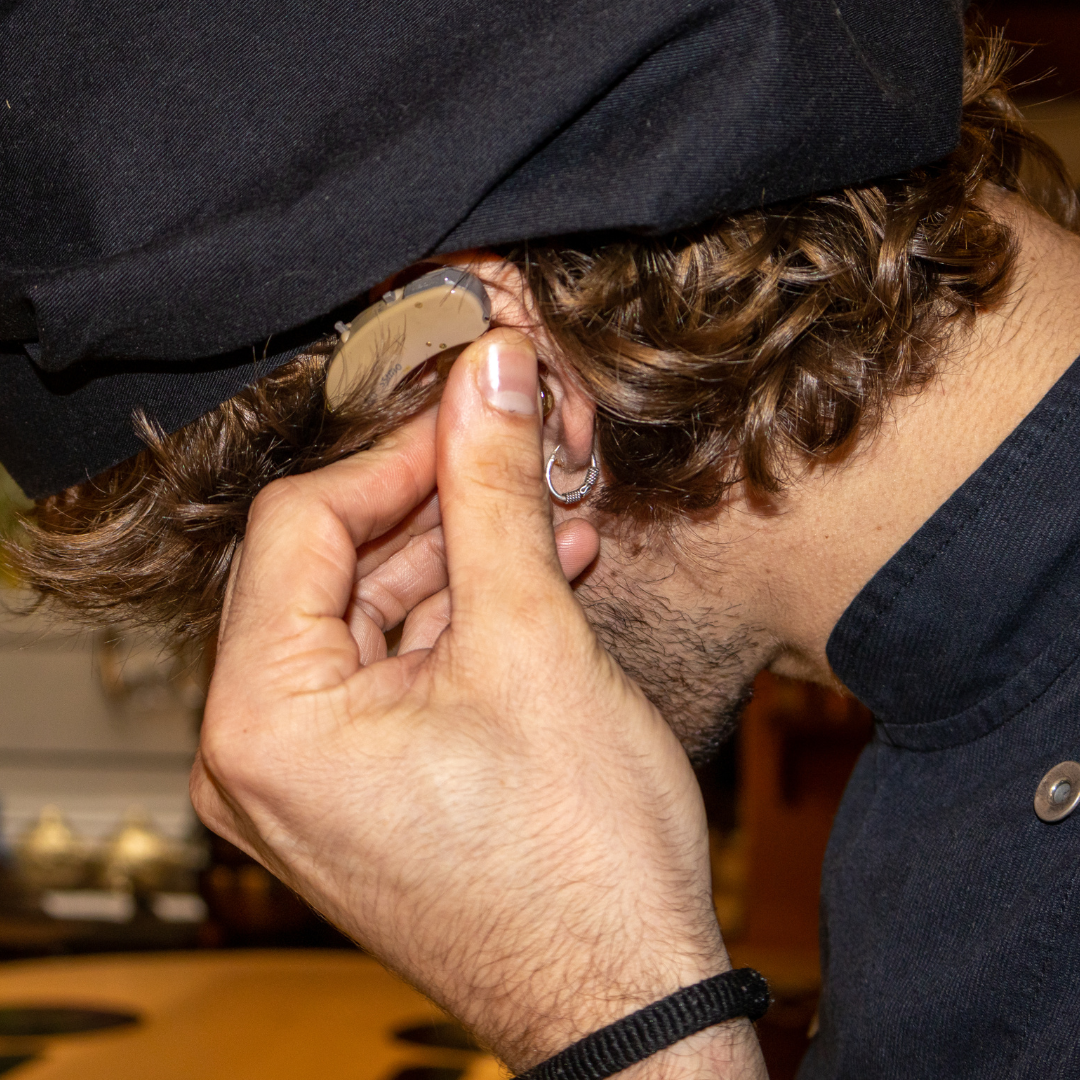
Appropriate hearing technology is dictated by the precise diagnosis, primary listening environments, and the degree of diagnosed hearing loss. Professionally fitted hearing aids may use directional microphones, digital noise reduction, and dedicated restaurant programs to emphasize speech from the front and reduce some competing sound. However, users must maintain realistic expectations, as no clinical technology can eliminate every competing background speaker entirely.
Pairing your devices with a remote wireless microphone generates a substantial improvement in the direct signal-to-noise ratio. The accessory is worn on the lapel or set near the speaker, streaming their voice directly into compatible hearing aids or wireless audio receivers. This strategy bypasses the detrimental effects of room reverberation, distance, and localized background chatter.
Alternative assistive hearing tools include:
- Dedicated table microphones engineered to capture small-group dialogue
- Telecoils or hearing-loop systems in equipped venues
- Mobile device live-captioning programs and speech-to-text transcription software
- Smart earbuds offering dedicated speech-in-noise amplification settings
- Sound-level meter applications and community-driven quiet dining guides
We will help compare available technology, verify device compatibility, and instruct you on utilizing your selected hearing equipment.
Clinical Audiology Care for Hearing in Complex Noise
A thorough audiological evaluation expands the diagnostic scope well past simple quiet listening performance. We examine the challenging acoustic venues, conversational setups, and noise profiles you encounter to select appropriate diagnostic tests. The diagnostic battery may encompass pure-tone thresholds, acoustic middle-ear evaluations, suprathreshold word recognition, and speech-in-noise measures. Advanced auditory-processing testing can be introduced whenever medical history and baseline assessments justify specialized evaluation.
Sudden unilateral hearing drops, acute asymmetric changes, or rapid auditory decline mandate evaluation by an ear, nose, and throat physician. Personalized care identifies the source of the difficulty rather than assuming restaurant noise is the only problem.
Schedule a Hearing Evaluation Today
If noisy restaurant gatherings leave you struggling to follow dialogue, pulling away, or feeling completely drained, schedule an audiological evaluation with our team. We will help you navigate hearing in noisy environments by implementing advanced hearing aid options, assistive accessories, or therapeutic auditory strategies tailored to your lifestyle.
Contact our audiology office today to schedule your evaluation and move toward effortless, confident conversations.